
Force of Nature Review: The Non-Toxic Disinfectant That Replaced Our Clorox Wipes

Written by Meg, mom of three (ages 5, 4, and 1.5) in Atlanta. I research like it’s my job and report back.
Is Force of Nature worth it?
Yes, for us. It’s the reason the heavy-duty Clorox wipes are gone from my house. It’s an EPA-registered disinfectant I’m comfortable spraying with kids and pets in the house, and it does the germ-killing my homemade vinegar spray can’t. The only downside is a small learning curve, which I’ll walk you through below.
Why I switched
After my daughter’s RSV hospitalization as a newborn, I kept the super-serious Clorox wipes handy for any illness that came through the house. Her older brothers had brought the bug home from daycare and I asked my sister, who's an NP, to help me put together a hospital grade sickness kit. Those wipes work, but they’re extremely strong, and they were never something I liked having around little kids. When I found Force of Nature, I ordered it, and after using it I promptly threw out the heavy-duty Clorox stuff.
One important caveat: Force of Nature is not registered to kill RSV. It isn’t on the EPA label and it isn’t in the brand’s own marketing, so I’m not going to tell you it does. If RSV is your worry (I get it), follow your pediatrician’s guidance.
What it actually is (the 60-second science)
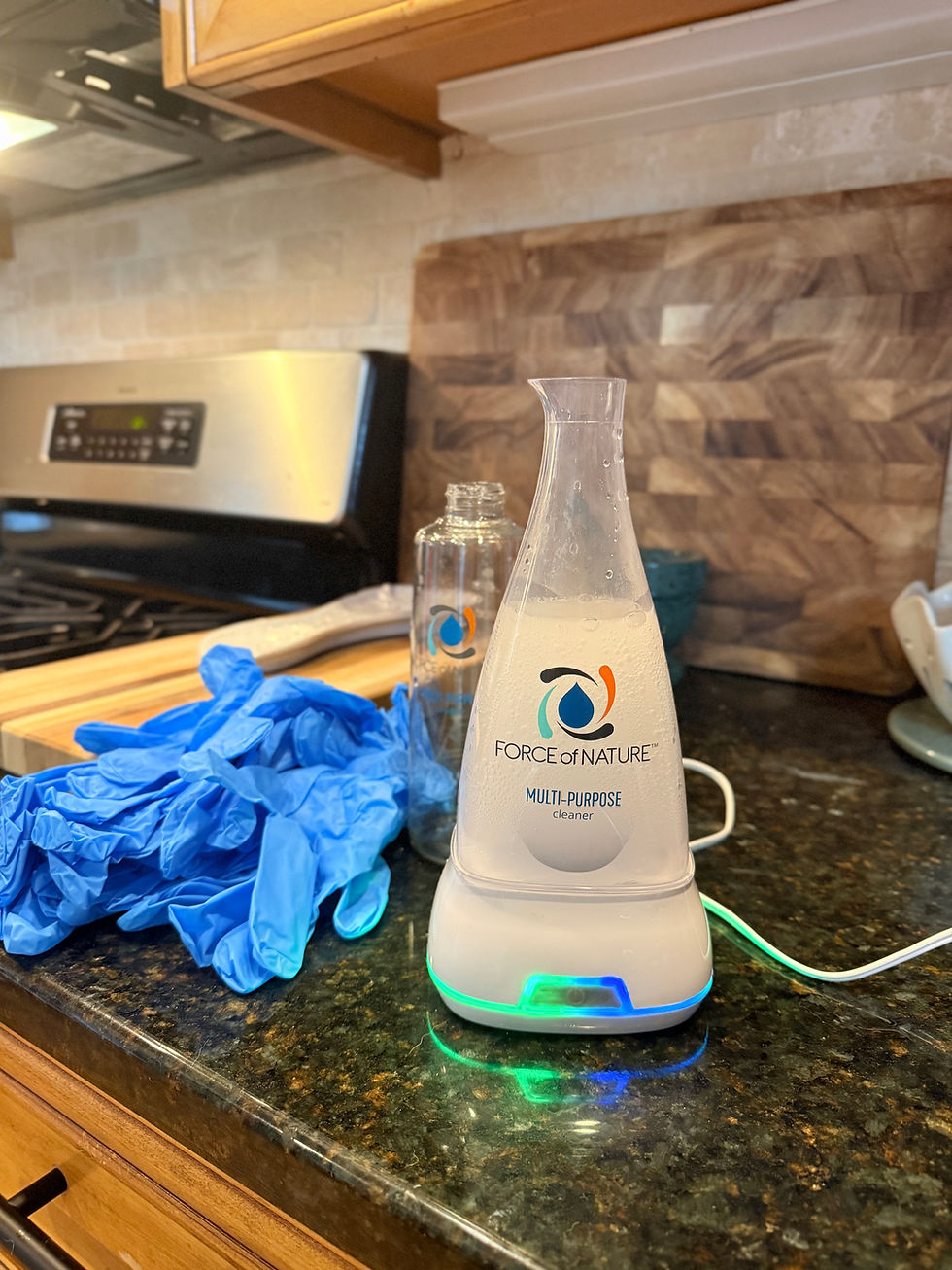
A little countertop device runs electricity through salt, water, and vinegar and turns it into hypochlorous acid, the same germ-fighting compound your own immune system makes. I was already a fan of hypochlorous acid from beauty products like Tower 28’s SOS Spray (a forever favorite), so that’s a big part of why this appealed to me. It’s also why this isn’t just “fancy water.” Hypochlorous acid is a legitimate disinfectant.
The catch: you make it in small batches, and per the label each batch is effective for up to 14 days. After that, you dump it and make a fresh one.
What it kills (and what it doesn’t)
Per its EPA label (Reg. No. 93040-1), on hard, non-porous surfaces:
Kept wet for 2 minutes: Staph, Salmonella, E. coli, Listeria, and Pseudomonas.
Kept wet for 10 minutes: MRSA, the flu (Influenza A), and norovirus, the stomach-bug one (tested via its EPA-accepted surrogate).
Not on the label: RSV, or any germ not named above.
Per Force of Nature's website it kills: viruses, bacteria, mold and mildew.
The fine print nobody tells you: disinfecting means the surface stays visibly wet for that whole contact time. A quick spray-and-wipe is cleaning, not disinfecting. And the disinfecting claims only cover hard, non-porous surfaces, not fabric or upholstery. The brand lists its other certifications on its certifications page.
💌 Want more like this? Subscribe here! All the good stuff goes to the email list first.
How we actually use it
Poopy bathtub cleanup. This is what we spray in the bathtub after a poopy cleanup. A tub is a hard, non-porous surface, so it’s exactly where the label applies: spray generously and let it sit wet for the full 10 minutes. It is great for odor killing too.
Sick season. It’s what I reach for now when illness comes through the house, instead of the harsh wipes I had to wear gloves to use. If you’re building a sick-day stash, it pairs with everything in my Ultimate Sick Kid Kit.
After my car was stolen. (A story for another day!) I sprayed it throughout the car interior until I could get it properly cleaned. Honest note: car seats and upholstery are porous, so the disinfecting claims don’t apply there. For me it was peace of mind and better than nothing, until a real cleaning.
Daily cleaning. I’ve made my own non-toxic house cleaner for five years and I still do, because I love how it smells and that it's safe to use around the kids. But it’s vinegar + Dr Bronner's, water and essential oils, which is for cleaning (wiping down the kitchen or bathroom counters) but not disinfecting. So we keep both: my homemade spray for everyday wipe-downs, Force of Nature for anything germy.
The only downside: the learning curve
It takes a minute to get the hang of it, mostly remembering how long a batch stays good (14 days per the label) and when to make a new one. Tip: write the date you made it on the bottle using tape. We have a bunch of different colored masking tapes which come off perfectly clean.
Once you see how well it cleans, it’s absolutely worth figuring out. Just know going in, it doesn't sit under your sink and come out ready to use anytime like the regular stuff.
The cost math
The starter kit is the upfront cost. After that, refill capsules are super cheap per bottle compared to buying single-use sprays. Like any gadget, the math only works if you actually use it and with three young kids and daycare germs that take no days off, we absolutely do.
Where to get it
Start with the Starter Kit. It’s the device plus enough capsules to know whether it sticks in your routine. Using my partner link supports this little corner of the internet at no extra cost to you 🤍
FAQ
Does Force of Nature actually disinfect?
Yes. It’s an EPA-registered disinfectant, not just a cleaner. Per its label, it kills Staph, Salmonella, E. coli, Listeria, and Pseudomonas with 2 minutes of wet contact, and MRSA, the flu (Influenza A), and norovirus with 10 minutes, on hard, non-porous surfaces. A quick spray-and-wipe is cleaning, not disinfecting.
Does Force of Nature kill RSV?
No. RSV isn’t on its EPA label, and the brand doesn’t claim it either. For RSV, follow your pediatrician’s guidance.
Does it work on stomach bugs?
Norovirus (the classic stomach bug) is on the label, with a 10-minute wet contact time on hard, non-porous surfaces. That’s the part most people skip, so spray generously and walk away.
How long does Force of Nature solution last?
Per the label, each batch is effective for up to 14 days from the day you make it. After that, toss it and make a fresh batch.
Can I use it on fabric, car seats, or the couch?
You can clean with it, but the disinfecting claims only apply to hard, non-porous surfaces. Anything soft or porous isn’t covered.
Is it safe to use around kids?
I’m comfortable using it around mine, which is exactly why it replaced the harsh wipes. The brand lists its safety certifications on its certifications page, and as with any cleaner, follow the label.
Keep reading
💌 Enjoyed this? Let’s be email friends — the good stuff goes to the list first.
— Meg 🫶
----------
Your friendly reminder that this blog is not medical advice! Always follow product labels, and talk to your pediatrician about anything health-related for your family.
Affiliate Disclosure: This post contains affiliate links, meaning I may earn a commission if you purchase, at no extra cost to you. Everything here is something my family actually uses. All clicks and purchases support this little corner of the internet!

